Finlayson Bousfield & Co., 1: Johnstone (1844-1898)

For over a century, five generations of the Finlayson family owned the flax mills in Johnstone. William Finlayson, born in Dunfermline in 1786, had a successful manufacturing business in Glasgow and was one of the first in Scotland to spin flax on machinery. In 1844, seeing Johnstone as an expanding new town, William, in partnership with his sons, James (1823-1903) and Charles (1825-1874), set up a flax spinning factory in the town.

In 1848 William’s sons, James and Charles, in partnership with a young Englishman, Charles Bousfield, founded Finlayson Bousfield & Co. and took over Barbush Cotton Mill, situated on the south bank of the Black Cart at Johnstone Bridge on the High Street as their new flax spinning mill. In the mid-1850s the company also owned Lilybank Mill, a smaller mill, situated on land behind Lilybank House in Brewery Street.

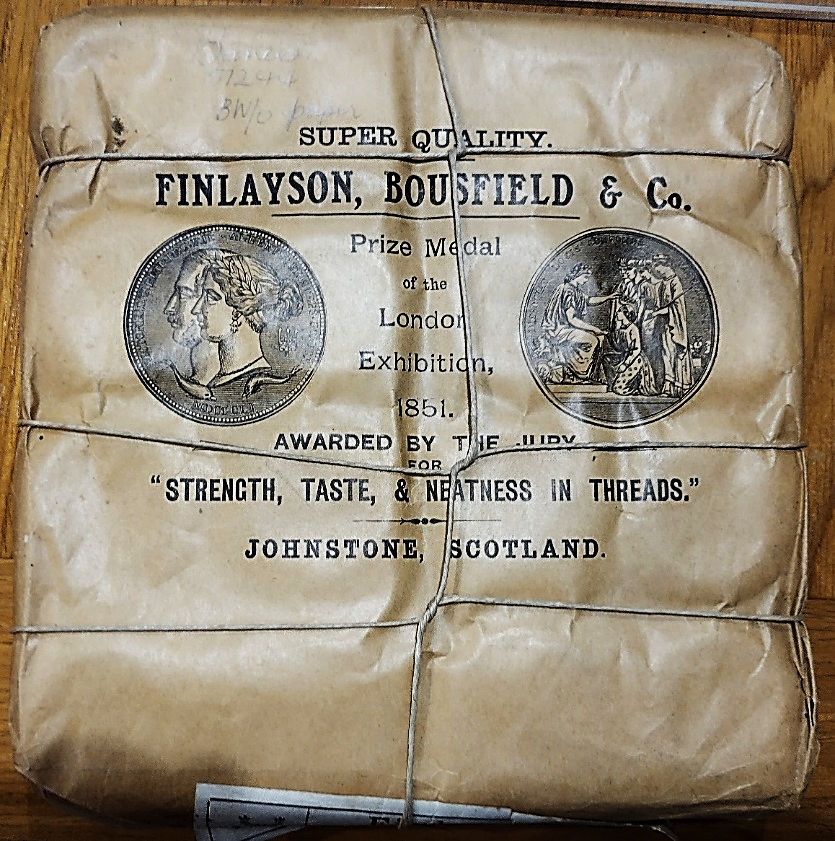
The company processed raw flax before it was spun in the spinning mill and the final process was the finishing and dyeing. In the early days, Finlayson Bousfield & Co. produced quality white and coloured threads. They sent their quality goods for display at national and international exhibitions. Probably their earliest exhibition was the London Exhibition in 1851 where the company was awarded a prize medal for the “strength, taste and neatness in threads”. To celebrate the award and to promote sales, Finlayson Bousfield used wrapping paper for their packages showing images of their 1851 prize medal. Two fine examples of this packaging are on display in Johnstone Museum 

The company quickly prospered and expanded and by 1856 Finlayson Bousfield’s Barbush Flax Mill was described as “an extensive establishment, adjoining Johnstone Bridge, for the manufacture of spinning thread”. By the 1860s Finlayson Bousfield & Co. had become the largest industrial plant in Johnstone and had its head office at 11 St. Enoch Square in Glasgow.

By the 1870s James’s sons, William, Archibald and James, Jun., were employed in the mills and business continued to develop and expand. The firm now owned Lancefield Mill, a small mill in Clark Street, and, in 1873, built a second large flax mill on the North bank of the River Cart at Johnstone Bridge. In 1881 Finlayson Bousfield’s Johnstone flax mills were documented as having a capital of £187,003 and 1700 employees, and were regarded as the largest flax mill in Scotland.

James and Charles had become not only successful wealthy businessmen, but also men of importance and influence in Johnstone who played a significant part in the development of the town. James had played a key role in the creation of Johnstone as a burgh in 1857. He founded the Flax Mill Workers Co-operative Society in 1866 which served the town for almost a century and built workers’ houses in Clark Street in 1872. In his sixties James stood for parliament and served as MP for Eastwood in 1885-1866. Charles, before his death in 1874, organized the building of Lilybank Bowling Green, for the use of the company’s employees. It has stood the test of time and is still a popular bowling green in Johnstone today.

For some years the company had been exporting abroad, notably to USA and Australia, where, Richard Allen & Co. of Melbourne were sole agents for Finlayson Bousfield of Johnstone. In 1878 James’s son, Archibald, was sent to USA to explore the possibility of setting up a new mill. Finlayson’s Flax Spinning Mill in North Grafton, Massachusetts, was up and running before 1885.

After consultation in 1897 with other well-established flax mills in Renfrewshire, Ireland and USA, Finlayson Bousfield & Co. in Johnstone and Finlayson’s Flax Spinning Mill in North Grafton, USA were founder members of The Linen Thread Company (1898-1968).

 Packaging: Courtesy of Johnstone Museum

© 2022 Helen Calcluth. Renfrewshire Local History Forum
Finlayson, Bousfield & Co., 2: The Linen Thread Company (1898-1968)

The Linen Thread Company was founded in 1898. It was an amalgamation of like-minded, successful linen thread manufacturers with mills in Scotland, Northern Ireland and USA. Finlayson, Bousfield & Co. was a founding member, and William, Archibald and James Finlayson (the three sons of James Finlayson, who established Finlayson Bousfield in 1844) were appointed to its first Board of Directors. The other founding members were the Finlaysons’ Flax Spinning Mill in North Grafton, Massachusetts; W. J. Knox Ltd. of Kilbirnie, Ayrshire; Wm. Barbour & Sons Ltd., Hilden Mill, Lisburn; Barbour Flax Spinning Co., Patterson, New Jersey; Barbour Brothers of New York  and Marshall Thread Co. of Newark, New Jersey. They were soon joined by seven other flax companies from Britain, Ireland and USA., including Crawford Brothers of Beith, Ayrshire.

The Linen Thread Company grew and expanded into a huge international concern,  with mills in Europe,  Australia  and South America.  Its Board of Directors insisted on the use of high quality flax, opened  scientific laboratories to ensure quality and innovation, and established a very productive and unrivalled world-wide sales organization through local agents. Throughout its existence, successive members of the Finlayson family from Johnstone, the Knox family from Kilbirnie and the Barbour family from Lisburn (the Barbours were descendants of the Kilbarchan Barbour linen merchants) were on the Board of Directors. The dedication and entrepreneurial skills of the directors ensured the success of the company, and was of significant advantage to the financial success of each independent member company. The UK head office was in Glasgow.

To manufacture quality thread, it was deemed essential to start with quality raw flax plants. In Finlayson Bousfield’s Johnstone mills quality raw flax was purchased from the Courtrai district in Belgium or from Ireland. It is likely that the  ponds on the north bank of the Black Cart (shown on OS Maps, Renfrewshire XI.8, 2nd ed., 1897 and later) were used as the retting ponds, although in some other of the Linen Thread Co’s flax mills, the soaking of raw flax was undertaken indoors. The flax was then taken to the drying room before the next processing stages of heckling and scutching, were undertaken by machine indoors. The processed flax was then ready to be sent to the spinning mill. The Finlayson Mill in North Grafton, USA, operated only as a spinning mill of  already processed flax.

In Johnstone, Finlayson Bousfield manufactured a wide variety of quality threads and cords, including hand and sewing machine threads, saddler’s threads, bookbinder’s threads, carpet thread, crochet thread, flourishing thread (for embroidery), glove thread, lace thread, and shoe thread. Samples of their finished products can be viewed locally in Johnstone Museum.

But all was not always plain sailing. In February 1902 at one o’clock on a Wednesday morning, a dramatic fire broke out in the company’s Napier Street Mill, which contained a large stock of finished thread ready for the market. At one end of the 200 feet long building, the fire burnt through the floor of the second storey and machinery fell into the burning mass below. Luckily, manufacturing was unaffected as the building was primarily used for storage and, due to a prudent insurance, the building could be repaired.

Despite this setback, Finlayson Bousfield continued to flourish for another 50 years. William’s son, Charles Kay Finlayson joined the company in the early 1900s and played an active part. His sons, too, later joined the company. William was Head Sales Director and Charles was Head Manufacturing Director of the Linen Thread Co. in the 1950s.

Although flax was the strongest natural fibre in the world, linen production declined in the 1950s when man-made fibres were introduced to the market. Both Finlayson Bousfield and The Linen Thread company ceased trading in the next decade and the main Johnstone flax mill site was later demolished.

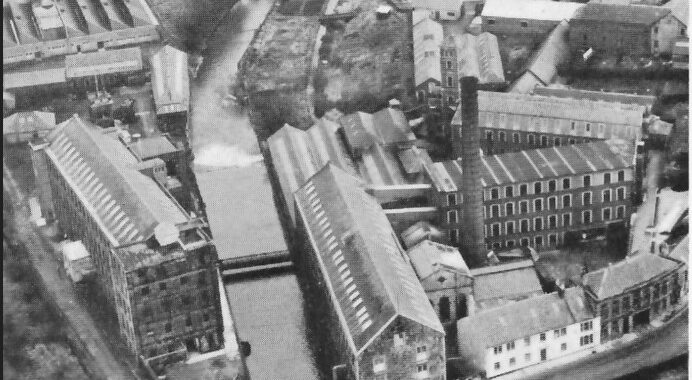
Finlayson Bousfield’s main  Flax Mill site in Johnstone

© 2022, Helen Calcluth, Renfrewshire Local History Forum

Finlayson, Bousfield & Co., 3

Little has been written about Mr Bousfield, who went into partnership with James and Charles Finlayson to form Finlayson, Bousfield & Co, in Johnstone in 1848. The only indication of his origin is found in an article by the Paisley Correspondent of the Glasgow Citizen describing the Johnstone Grand Industrial Exhibition, held in the town in 1853. Mr  Bousfield had contributed  specimens of silk tabaretts, and silk damask and tissues, for display at the exhibition and these had been manufactured chiefly at Spitalfields. This information indicated a possible clue to his past and merited further investigation.

Recent research has revealed that Charles Holehouse Bousfield was born in London on 9th of February, 1822, and baptised in St. Olave, Old Jewry, London. His mother was Sarah Holehouse and his father, Charles Pritchett Bousfield, was a silk manufacturer in London. As children, Charles and his siblings are likely to have lived in a very busy household, which may have included on the premises his father’s indentured weaver apprentices.

In 1836, at the age of fourteen, Charles was indentured as an apprentice to his father to learn the Art of a Silk Manufacturer. In 1843, on completion of his apprenticeship, young Charles was admitted as Freeman of the City of London. In the late 1840s, when he came to Scotland, possibly on business for his father who was a partner in Lea, Bousfield & Co., silk manufacturers in Cheapside, London, he appears to have been well-respected in Glasgow business circles. Presumably, with an eye to the main chance, he saw in James Finlayson the potential of future success and went into partnership with him to form Finlayson, Bousfield & Co. In 1851, and possibly earlier, he is known to have lodged with William and Helen Finlayson, the Finlayson brothers’ parents, beside the mill at Johnstone Bridge in the  High Street. He is listed as a proprietor of Finlayson Bousfield in Johnstone in 1855 and1865. But, unlike the Finlayson brothers, little of his personal life or social involvement in Johnstone is recorded.

In addition to his contribution of silk goods on display at the Johnstone Grand Industrial Exhibition (1853), he is known to have hosted a meeting in the Public Hall in Johnstone in November, 1873, when Sheriff Clerk of Glasgow gave a history lecture to the Johnstone Working Men’s Institute. One perhaps more significant mention of him is contained in the text of Charles Finlayson’s address to the guests at the opening of  Finlayson Bousfield’s Lilybank Bowling Green in 1874. In the address it is mentioned that Mr Bousfield, although a partner in the firm, was not well known to the Flax Mill employees. This may be explained by the fact that by the late 1860s he was living in Glasgow.

Despite the success of the company, Charles Holehouse Bousfield ended his partnership in Finlayson, Bousfield & Co. on 13th November, 1876. It is documented that he would have no further interest in the business which would be carried on under James Finlayson, Thomas Coats, and James’s three sons, William James Finlayson,  Archibald Watson Finlayson and James Finlayson, Jun.

Charles Holehouse Bousfield appears to have had returned permanently to London where  his main residence  was 40 Elvaston Place, Queensgate, Kensington. In London he was a member of the prestigious gentlemen’s club, the National Club, London, and had involvement in charities and mission work.  He died at 29 Ashburn Place, on 12th March, 1906, and was buried in Norwood Cemetery, Lambeth, leaving a considerable fortune of £497,962. 17s. 2d. to his sister, Cornelia, the widow of Hugh Huleatt, and £45,885.12s. to her daughter, Frances Emma Huleatt, widow of Archibald Mungo Muir. But how he accumulated this substantial estate is a mystery.

© 2023 Helen Calcluth,